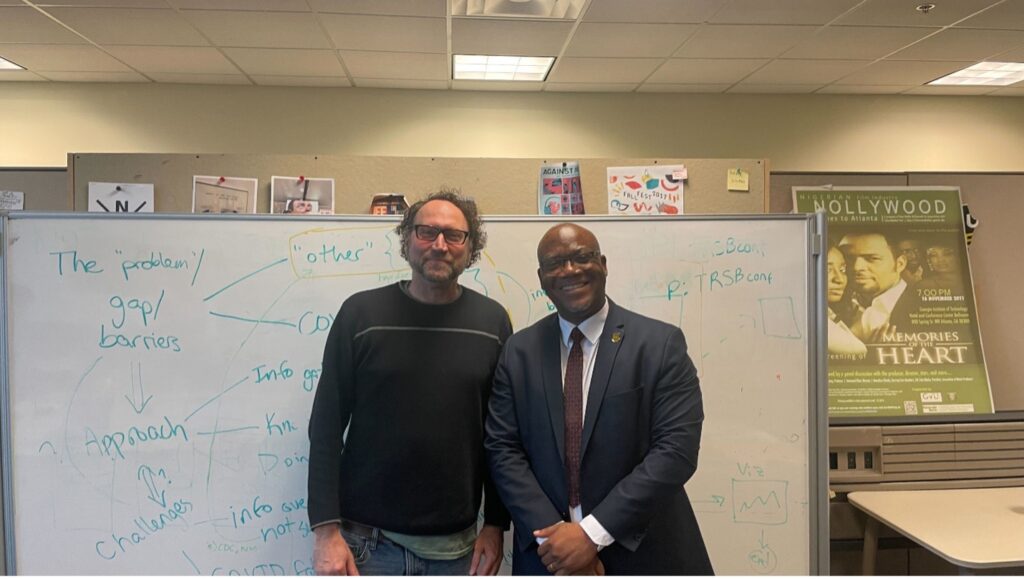
One objective of the Responsible AI Lab (RAIL) is to deepen the understanding of how responsible AI tools and frameworks can be developed and applied to advance computer, biomedical, agricultural and ecological sciences. To achieve this objective, the PI and Scientific Director, Prof. Jerry John Kponyo, gave a lecture on Responsible AI and Ethics, a quantitative view from Africa, on 7th October 2022 at the Georgia Institute of Technology (Georgia Tech), USA.
He stated that AI should be responsible for ensuring that AI solutions are delivered with integrity, and equity, respecting individuals, and always being mindful of its social impact. “There is a need to evaluate AI solutions according to established standards (ISO 26000) and frameworks (FACT, FATE, FACETS)”, he added. In addressing the quantitative view of responsible AI, Prof. Kponyo mentioned the need to provide a measure of how responsible an AI solution should be and an agreed standardized framework which helps to compare the performance of AI solutions globally. “A quantitative measure limits subjectivity in evaluating AI solutions,” he asserted.
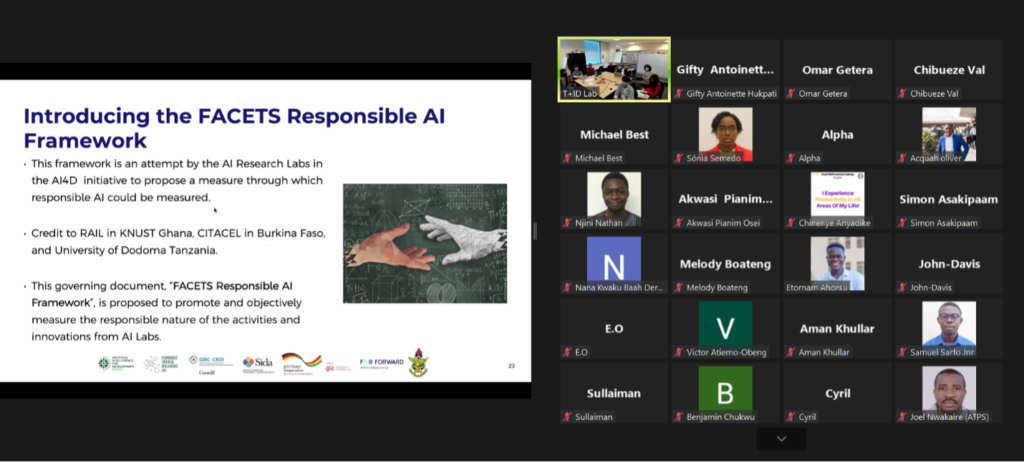
He introduced the FACETS framework as an attempt by the AI research labs in the AI4D initiative to propose a measure through which responsible AI could be measured. He said the credit for this framework should be given to RAIL in KNUST Ghana, CITACEL in Burkina Faso, and the University of Dodoma Tanzania when used. He added that the governing document, “FACETS Responsible AI Framework”, is proposed to promote and objectively measure the responsible nature of the activities and innovations from AI Labs.
He indicated that FACETS considers a pipeline that captures the whole process from envisioning to deployment in measuring performance and considers the various stages of the AI innovation process. He revealed that F, A, C, E, T, and S stands for Fairness, Accountability, Confidentiality, Ethics, Transparency and Safety measures, respectively, and the overall weight distributions for the various pipeline sections are as follows:
- Envision – 30%
- Data – 20%
- Model – 25%
- Deployment – 25%
He concluded by saying that RAIL seeks to collaborate with key research laboratories globally to drive the frontiers of the responsible use of AI, and his presence at Georgia Tech allows collaboration in AI research. “Let us work together towards the responsible use of AI for good,” he reiterated.